ESST Research
A unique research network in the humanities and the social sciences, An ideal partner for international and national research proposals/projects
The ESST research network consists of more than a dozen of universities across Europe, about one hundred faculty and affiliated researchers, over a thousand graduates who work in the public and private sector all around Europe, more than fifty students who work on research theses each year. This makes ESST an ideal partner for international (EU and other) and national research proposals/projects, in all fields of science, technology and medicine.
ESST offers a range of Research Electives within the interdisciplinary field of study known as Science, Technology, Society or Science and Technology Studies (STS). From theory to policy, the research of the ESST community covers all major societal challenges: scores of ESST researchers work on research projects of relevance to the environmental crisis, critical sub-fields of ICT (e.g. artificial intelligence, IoT, big data, robotics, digital commons), the promises and risks of biology, biotechnology, biomedical and medical science and technology. ESST research links Science and Technology Studies to many other important fields (from Innovation Studies and Communication/Media Studies to Policy Studies, Gender Studies, Border and/or Migration Studies, Disability Studies).
The research undertaken in the context of the ESST network benefits from close contact with a number of research institutes, departments and groups at the ESST partner universities, which undertake research that extends from the mathematical and physical to the life sciences, and from all fields of medicine to all disciplines of engineering. Through ESST, they are linked to a large number of researchers from the humanities and the social sciences, also working in institutes, departments and groups in the ESST partner universities.
Through their participation in international and national research projects, members of the ESST research community lead in STS projects as well as in projects in science-engineering-medicine that require the participation of the humanities and the social sciences (for samples, click here). They play a crucial role in functions that range from management to dissemination of (and engagement in) research.
If you are interested in having ESST as a partner in your prospective international or national research project, you may contact the ESST vice-president of research (Aristotle Tympas, at tympas@phs.uoa.gr)
-
Closing Symposium of the E4C Project
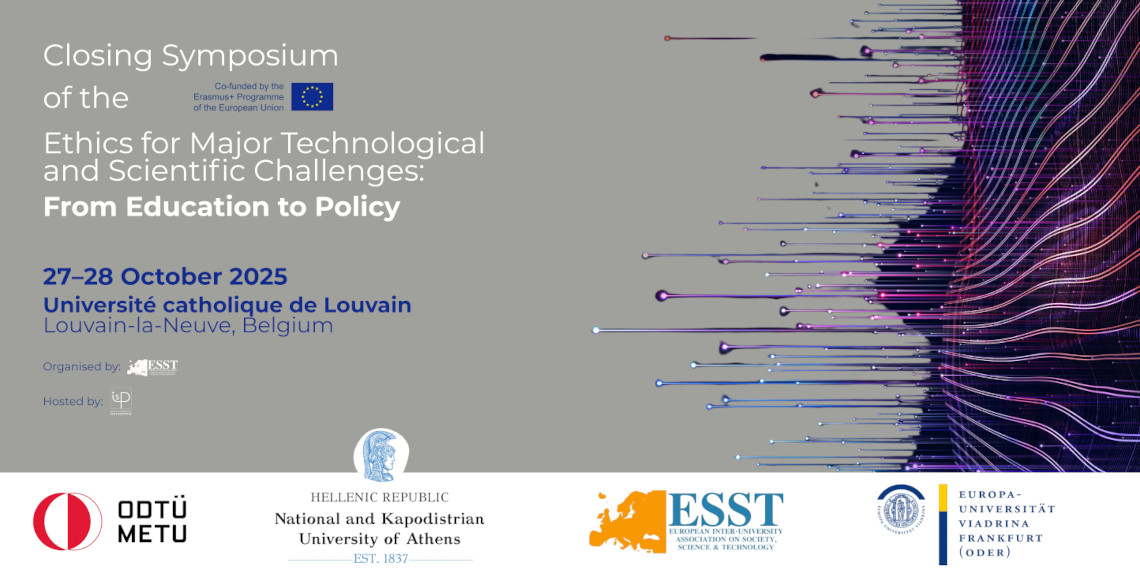
Location: Higher Institute Philosophy – Isp UclouvainRoom a.124 Salle du conseil Press Release 27–28 October 2025 | Université catholique de Louvain, Louvain-la-Neuve (Belgium) The Erasmus+ project ETHICS4CHALLENGES (E4C) will hold its closing symposium From Education to Policy on 27–28 October 2025 at the Université catholique de Louvain. Over the past three years, E4C has developed…
-
Questionnaire on Ethics Education of Science and Technology in the Academic Sector
This survey is part of the Erasmus+ project ETHICS4CHALLENGES, which aims to produce an online ethics education platform. The goal of this survey is to map the current status and perceived needs for ethics education, particularly in the fields of digitalisation, biomedicine and environmental sciences and technologies, in higher education. You will need approximately 20 minutes…
-
Participation in Ethics4Challenges Erasmus+ Programm

ContentsAimActivitiesExpected ResultsFunded By Aim Environmental degradation, advances in biomedicalization, and rampant digitalization are three major contemporary challenges, coextensive with scientific-technological civilization itself. ETHICS4CHALLENGES aims at addressing them through flexible ethics education pathways to inculcate the necessary ethical awareness in students of all backgrounds(engineering, sciences, social and human sciences) and foster critical thinking about science/technology…