
Socio-Ecological Change,
Policy, and Innovation
Aalborg University, Denmark
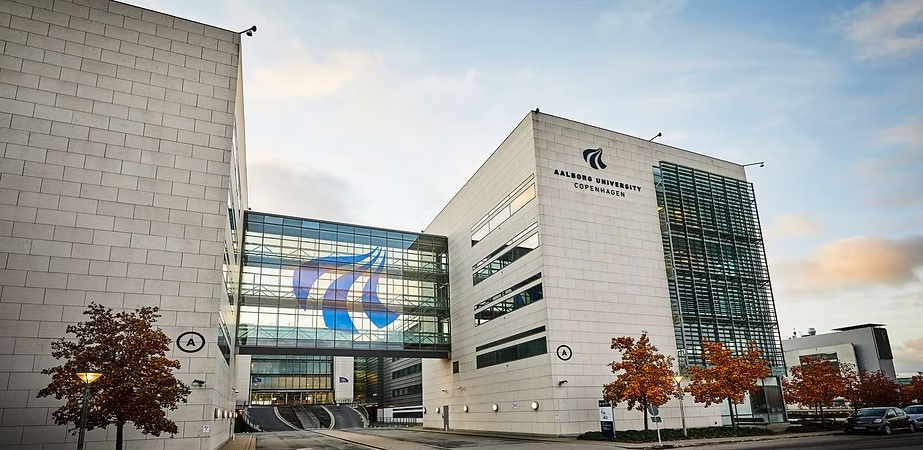
General Description
It is widely recognised that human-induced climate change, long-term sustainable development and social and environmental justice represents some of the most pressing and multifaceted societal challenges which requires decisive and resolute actions, and rests on a multitude of factors, stakeholders, and actors. Tackling the aforementioned issues is central to achieving the green transition of societies around the world and addressing the 2030 Agenda. The aim of this elective is to understand the processes of socio-ecological change and to explore how state and non-state actors are responding to these challenges and shaping the green transition in the global North and South. These topics can be formulated within three interdependent themes that each or in combination form the overall focus of the ESST thesis.
Theme 1: Ecological Change, Ecocide, and Environmental Policy
The first theme focuses on the problems and dilemmas related to environmental sustainability, the emergence of environmentalism as a political force, and policy responses to addressing environmental challenges. From a political ecology perspective, this theme discusses the relationships and dynamics between political, economic, and social factors that are central to environmental issues from a range of spatial scales.
Theme 2: Climate Change, Environmental Justice, and Rights
The second theme considers the relationship between environment and society by examining the environmental injustice of climate change and its impact on human and environmental rights. Through an environmental justice lens, this theme focuses on climate policy and the power dynamics associated with climate change, the role of knowledge of climate change and its drivers, the inequalities, and injustices of climate change, as well as environmental and climate justice movements.
Theme 3: Innovation and the Green Transition
The third theme discusses changes to the social, economic, and political landscape to enable the green transition towards a sustainable society and the changing ways society views and values the environment. This theme looks at different innovative ‘green’ solutions and policy instruments for green growth and innovation as countries embark on the green transition.
Elective structure and requirements
To address the issues related to socio-ecological change, policy and innovation, the electivecombines both theoretical and practical insights though problem-based learning (PBL). The PBL-based pedagogical model of Aalborg University has become both nationally and internationally recognised by universities, researchers and students as an advanced and efficient learning model. The elective (including thesis supervision) is conducted in collaboration with Department of Politics and Society, which is dedicated to the study of political and societal developments with local, national and /or international relevance. Our faculty research the past and the present in an effort to shape the future, and we transmit our research into a number of high quality educational programs.
To support the individual thesis work, ESST students will follow 3 modules together with other groups of students within political science. To deal with a research project that will result in an ESST thesis, students will receive a skills training in project management in the first module. The other module at the start of the electivewill introduce students in the three themes (policy, rights, and innovation) so they can make an informed choice about the specific focus of their thesis. The exam of this second module will be the research proposal (for requirements see ESST Handbook). The final module (thesis project) will help students with their time management as it requires students to deliver a paper that describes the background of their thesis topic; a research question and an explanation of the relevance of this question; a literature review; an explanation of the theoretical framework; and a description and legitimation of the methods used for data collection and analysis.
Besides giving the ESST students an opportunity to meet and interact with other Danish and international students, the 3 modules will provide input in form of overview of the related themes, literature, methods and project management skills. The modules, as outlined below, are Sustainability and Project Management Course, Topical Seminars, and Semester Project. The 3 modules are closely related, as explained underneath. Combined, they are input for a thesis which can be submitted at the ESST students home university.